
Start with the room, not the lamp
Before you choose a handmade light, measure the space and think about what the room needs to do. A pendant over a dining table, a bedside light and a ceiling feature all ask for different proportions and different levels of brightness. In a compact Maboneng apartment, a wide sculptural shade can overpower the room. In a double-volume lounge, the same piece may feel too small and get lost.
As a simple guide, check ceiling height, table width and the distance between the fitting and the people using the room. For a dining table, the shade should usually sit about 75 to 90 cm above the table surface. For a bedside fitting, make sure it leaves enough space for reading without glare. If you are fitting a cluster over a staircase or entrance, look at the view from below as well as from across the room.
- Measure the room in metres before you choose scale.
- Check where shadows will fall, especially over worktops and reading chairs.
- Think about whether the light is for mood, task use or both.
Look closely at light quality, not only the shape
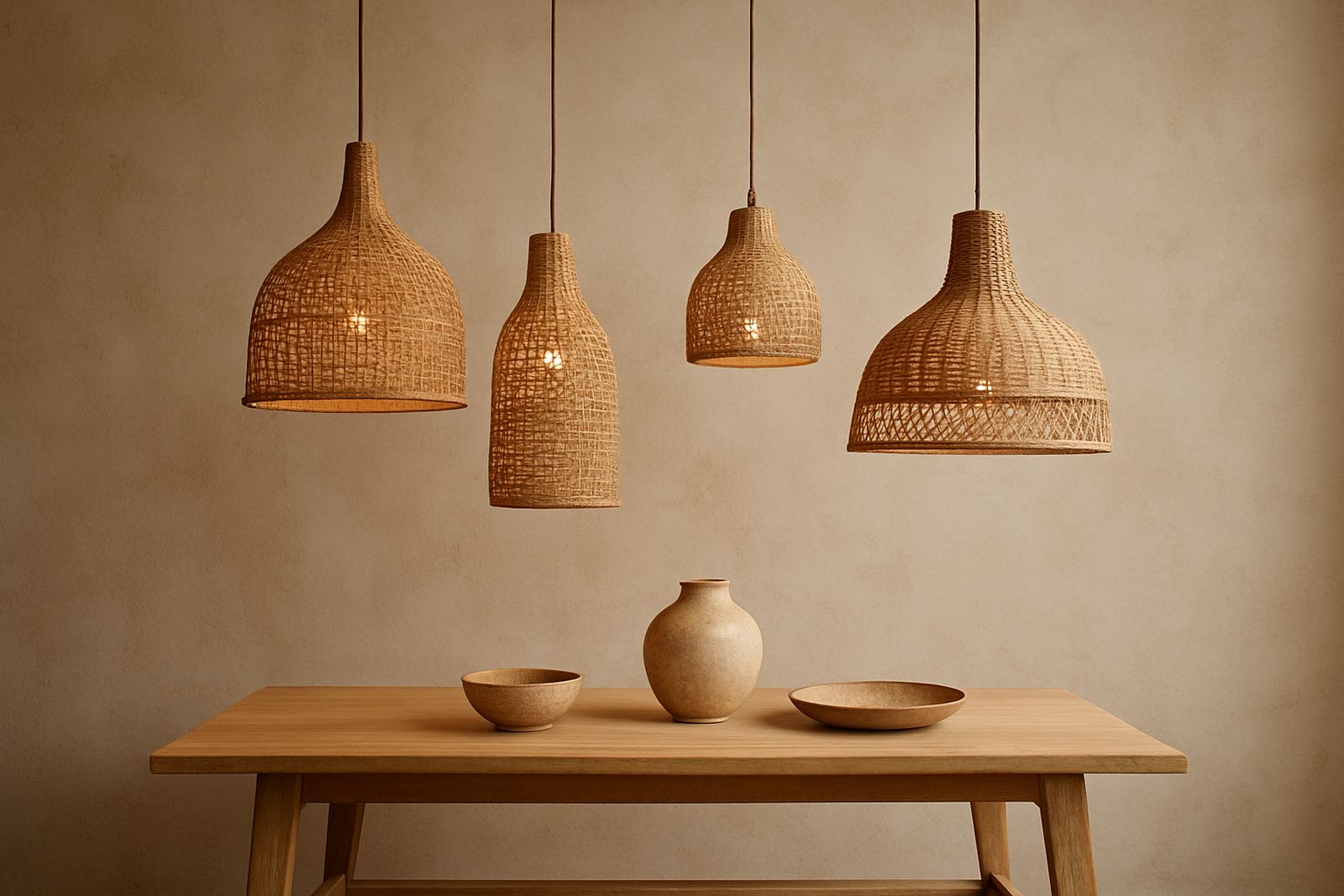
Artisan lighting often uses woven fibres, ceramics, metalwork, glass or fabric, and each material changes the way light behaves. A perforated shade throws pattern and texture onto walls. A ceramic form may give a softer pool of light with more contained glare. Open-weave pieces are attractive, but they can be too bright if the globe is not screened or if the lamp is used in a small room.
In South Africa, where many homes use lighting through load-shedding and backup systems, it helps to keep efficiency in mind. LED lamps are usually the most practical choice for handmade fittings because they use less power and give less heat, which is kinder to natural materials and better for daily use. Warm white light works well in living areas and bedrooms, while a cleaner neutral tone may suit kitchens, workspaces and retail displays.
- Ask how much of the bulb is visible through the shade.
- Check if the fitting accepts standard LED bulbs that are easy to replace locally.
- Test the light at night, not only in a bright showroom or studio.
Materials must suit the coast, the city and everyday cleaning
Handmade lighting is often chosen for its character, but the material still has to cope with daily life. In Cape Town and Durban, coastal humidity can affect untreated metal, timber and some woven materials. In Pretoria and Johannesburg, dust build-up is more likely, so surfaces should be easy to wipe down. If a piece is going into hospitality or retail, it also needs to handle frequent cleaning and some knocks from staff and guests.
Ask how the piece has been finished. A painted metal frame may need less care than bare wire. Sealed timber performs better than raw timber in kitchens. Ceramics are durable, but the weight must be suitable for the ceiling point and fittings. Natural fibres can look beautiful in restaurants and guest houses, but they should be checked for fraying, sagging or fading if they will sit in direct sun.
- Choose finishes that can handle dust, moisture and repeated cleaning.
- Check the weight if the fitting will hang from a gypsum ceiling.
- For coastal areas, prefer treated surfaces that resist rust and warping.
Check the wiring and mounting before you commit
With artisan lighting, the visible form gets most of the attention, but the wiring and mounting matter just as much. A beautiful shade is not enough if the socket is loose, the cable is thin or the fitting cannot be secured properly. For homes, guest lodges and small restaurants, ask whether the light can be installed by a qualified electrician and whether the mount suits local ceiling types.
If the fitting is being shipped to another city or country, packaging becomes part of the quality check. Fragile pieces need protection for shade edges, bulb holders and any decorative parts that can shift in transit. For export orders, it is worth confirming whether the piece can be packed flat, boxed in sections or shipped fully assembled. That affects both courier cost and the chance of damage.
- Confirm the fitting type, cable length and ceiling fixings before ordering.
- Ask whether replacement parts can be supplied if a holder or cord is damaged.
- For export packing, check the final box size and the handling notes for fragile goods.
Match the piece to the setting, whether it is home or hospitality
Artisan lighting works well when it feels placed, not just purchased. In a home, that may mean a single pendant above a breakfast table or a pair of bedside lamps with handmade shades. In hospitality, the same pieces may need to be repeated in a considered way so the look stays consistent across rooms or tables. A guesthouse in Pretoria might use one family of fittings in the reception area and simpler versions in the rooms, while a Cape Town restaurant may want a run of pendants that gives rhythm over the bar.
For merchants and interior buyers, consistency matters as much as beauty. If you are ordering for retail or a project, compare dimensions, finishes and lead times across the full set. Handmade pieces will vary slightly, which is part of the appeal, but the variation should be controlled enough for the space. That is where sample loans and collection consultations help, because you can see how scale and light quality behave before committing to a larger order.
Local example: a Soweto townhouse with a narrow dining area might suit one ceramic pendant rather than three small ones. The single piece gives enough focus without crowding the table, and it avoids visual clutter in a room that already has limited ceiling height.
Ask the maker for care notes and provenance
Buying artisan lighting is also about understanding where the piece comes from and how to look after it. Provenance cards are useful because they record the maker, materials and care steps in plain language. This helps with resale, gifting and hospitality use, where guests often ask about the story behind what they see. It also gives the buyer practical information for future maintenance.
Good care advice should be specific. A woven pendant may need a dry cloth only. A ceramic base may need careful handling during cleaning. A metal fitting may need periodic checks for corrosion or loose fixings. If the light has a natural finish, ask whether it should be kept away from direct sunlight or strong heat sources. For larger orders, seasonal editing and bulk planning can help you choose pieces that suit the time of year, the type of space and the budget in Rand.
When buying through a marketplace that works with makers across Africa, you get access to a wider range of materials and techniques, but the decision should still be practical. Measure first, test the light quality, check the material and confirm the wiring. That way the piece does the job as well as it looks.