Start with the item, not the box
Good packing starts with understanding what is actually being sent. A hand-thrown ceramic bowl, a woven basket with a glass insert and a textile wall hanging with wooden elements all need different support. Weight, shape, finish and movement inside the parcel matter just as much as the courier label.
Before anything goes into a carton, we check where the weak points are. Handles, rims, spouts, corners and glazed surfaces need extra care. If the item has a lid or detachable part, that should be packed separately and clearly marked. The aim is to stop pieces from knocking against each other when the parcel is lifted, stacked or turned during transport.
For orders going from Maboneng to Cape Town, Durban, Pretoria or abroad, the route changes the packing plan too. Long road trips, airport handling and coastal humidity all affect what goes inside the box and how tightly it should be secured.
Build layers that stop movement
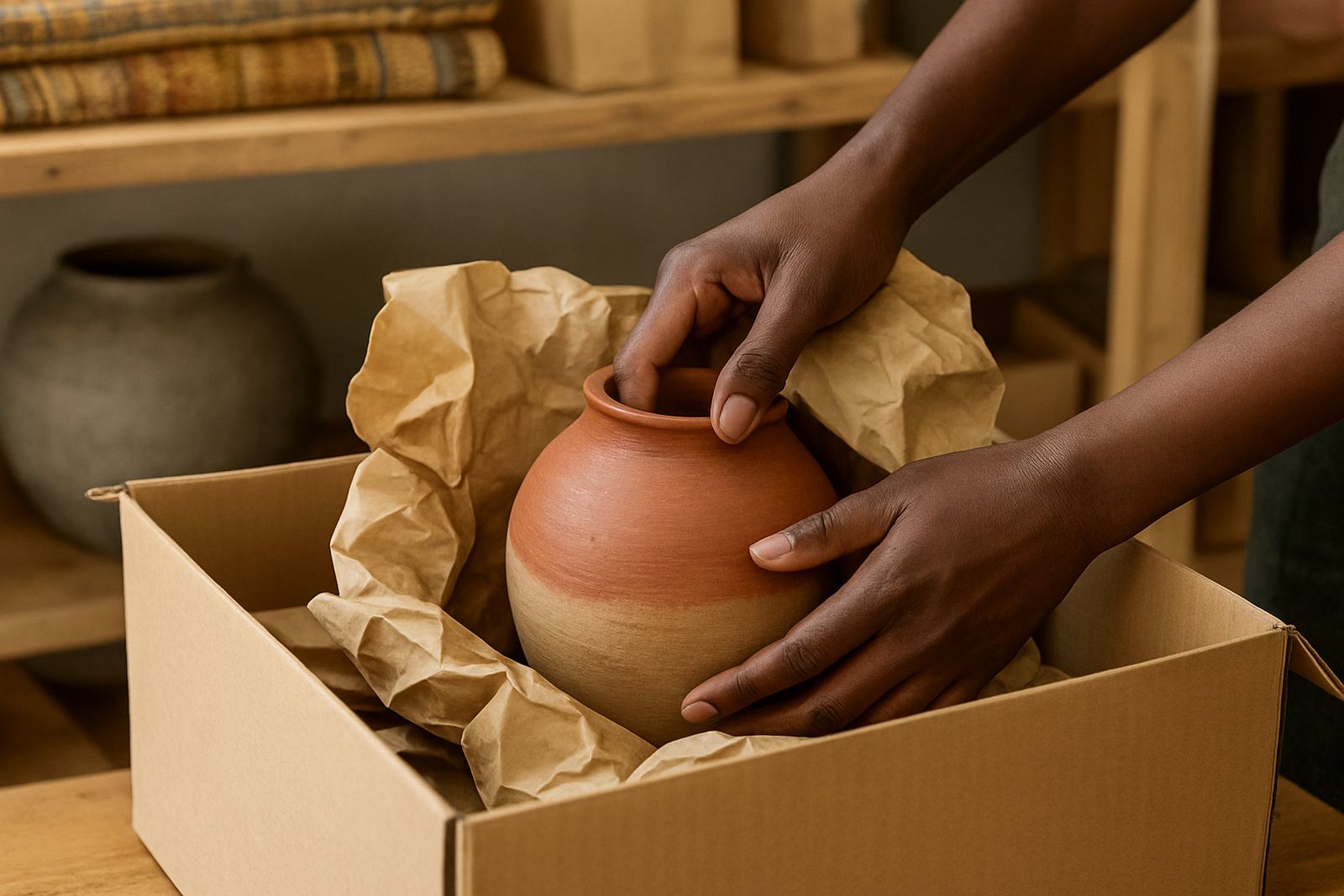
Internal protection is what saves fragile orders. The outer carton matters, but the real protection happens inside the box. Every item should be wrapped, cushioned and blocked so it cannot shift when the parcel is shaken. If a ceramic piece can move even a few millimetres, it can crack on a corner or chip at the rim.
- Wrap each item on its own, never in a shared layer.
- Use soft paper or tissue first, then cushioning around the full shape.
- Fill hollow spaces so there is no rattling inside the parcel.
- Keep heavy pieces separate from lighter or more delicate ones.
- Use a box size that allows protection without leaving large empty gaps.
For mixed-material orders, the packing sequence should be planned in advance. A ceramic vase should never sit directly against a wooden frame or metal fitting. Different materials move differently under pressure, and that friction causes damage. Layering is not about making the box bulky, it is about stopping contact between surfaces that should not meet.
Use the right carton for the weight
Many fragile parcels fail because the box was too light for the contents. A carton that looks neat but gives in at the base is no help at all. For heavier ceramics or multi-item orders, the outer box must hold its shape under stacking pressure and handling. Double-walled cartons are usually the safer choice for export packing and for local courier runs where parcels are sorted several times.
Sealing also matters. Tape should run across every main seam and over the base, not just the top flap. If the box opens slightly during transit, internal packing shifts and the whole order becomes vulnerable. We also avoid overfilling, because a swollen box is more likely to burst at the corners.
When the weather is humid, especially in Durban and coastal areas, packaging can pick up moisture. That is where a clean inner wrap and a strong outer carton help protect paper labels and surface finishes. For long-distance deliveries, a well packed box is worth more than fancy outer presentation. It has to survive the trip first.
Give ceramics extra protection at the edges
Ceramics are often strongest in the body and weakest at the edges. The rim of a plate, the handle of a mug and the lip of a bowl can fail from a small impact that would not bother the rest of the piece. That is why edge protection is a proper part of packing, not an optional extra.
For plates and shallow vessels, we pack them upright when possible rather than flat, because that reduces pressure on the centre and spreads the load more evenly. For mugs and jugs, handles should be cushioned so they do not become pressure points. Where a set contains multiple ceramics, each one needs its own barrier before the items are grouped together in the carton.
A local example: a small ceramic breakfast set going from Maboneng to a guesthouse in Pretoria may travel by road in a van, then be handled again at the property gate. If the cups are packed loosely, the first bump can lead to chips before the parcel is even signed for. A proper corner buffer and close internal fit can prevent that kind of loss.
Label clearly and keep the paperwork with the parcel
Good packing is not only about cushioning. Clear marking helps the people handling the parcel know what is inside and how it should be treated. Fragile labels should be visible on more than one side of the box, and the sender details should be easy to read if the outer label gets damaged.
- Mark the parcel as fragile on the top and at least one side.
- Use a contents note inside the outer carton for mixed orders.
- Separate export paperwork from the item itself but keep it in the same shipment file.
- Include provenance cards or product notes in a protected sleeve.
- Make sure the receiving address is complete and current before dispatch.
For international orders, paperwork must also match the contents. If the parcel contains ceramics, textiles and artisan goods together, the description should be accurate enough for customs and courier processing. That reduces delays and helps avoid unnecessary opening and resealing of the box.
Plan for customer expectations and the last mile
The best fragile packing still has to meet real delivery conditions. A parcel may be moved into a sorting cage, loaded into a truck, left in a warm warehouse or handed over at a reception point. Load shedding can affect warehouse timing and collection schedules, so parcels may wait longer than planned before they move. Packing has to account for that pause as well as the trip itself.
For clients in Sandton, Midrand, Soweto, Pretoria, Cape Town, Durban and Gqeberha, we plan the final leg with the same care as the first wrap. If an order contains several delicate pieces, it may be better to split the shipment or add extra internal bracing rather than forcing everything into one parcel. That saves breakages and it often saves money in the end.
When customers ask what makes fragile packing worthwhile, the answer is simple. It protects the maker’s work, it protects the buyer’s order and it cuts down on returns, claims and disappointment. A parcel that arrives in one piece says the whole process was considered properly from the start.
When to choose a more careful packing plan
Some orders need a basic wrap, while others need a full packing plan. If the item is glazed, uneven, oversized or part of a mixed set, the parcel should be treated as a fragile shipment from the beginning. The same is true for gifts, hospitality pieces and export orders where presentation and condition both matter.
We recommend a more careful plan when an order includes any of the following:
- Multiple ceramic pieces in one parcel
- Mixed materials such as wood, glass, metal and clay
- High-value gifts or presentation orders
- Export consignments with longer handling chains
- Seasonal bulk orders that will sit in storage before delivery
For buyers and trade clients alike, a careful packing method is part of good service. It shows respect for the object, the maker and the person receiving it. In a city like Johannesburg, where parcels may travel across town before they ever leave the province, that extra attention is often what keeps a fragile order safe.